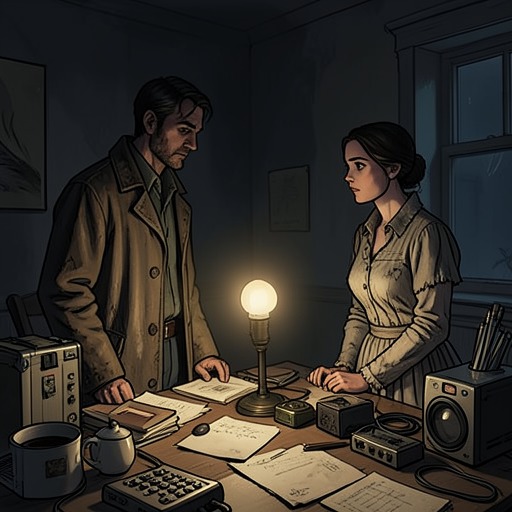
Henry and Clare’s first meeting in the meadow
The Time Traveler's WifeHenry and Clare’s first meeting in the meadow begins their relationship through a collision between incompatible timelines: Henry knows Clare as his future wife, while six-year-old Clare sees a naked, unfamiliar man in her secluded place. Their encounter on September 23, 1977, becomes a recurring memory whose details emerge at different points in the novel, so that its promises, fear, and recognition are pieced together across time rather than presented as a single, settled past.
The Encounter and Its Setting
Henry arrives in the Meadow from the future and waits outside the clearing, naked because the clothes Clare usually leaves for him in a box under a stone are absent. The missing box tells him that he has landed in a time before he and Clare have met. He hides in the tall grass rather than risk being seen by Clare’s family, hungry and uncertain whether Clare has even been born yet. When he hears a screen door slam, he looks up and sees a child running toward the clearing.
Clare is alone and absorbed in a quiet activity. Still wearing her school uniform, she spreads a beach towel on the ground, empties a Marshall Field’s shopping bag of pens, pencils, crayons, and markers, and tests them one by one on paper. She hums while she works. Henry recognizes the tune as the theme song of The Dick Van Dyke Show and, hesitating to intrude on her, hums along. Clare notices him. Their first contact is thus not a planned introduction but an interruption: Henry’s familiarity with her meets her justified alarm at a stranger who knows her name.
Fear, Disclosure, and a Future Appointment
Clare throws a shoe at Henry, injuring his mouth. When he identifies himself, she remains wary and demands her shoes back. Henry tosses them into the clearing and explains that he is hiding because he has lost his clothes. He tells her that he has come from the future, that he is a time traveler, and that in the future the two of them are friends. Clare objects that time travel belongs in movies. Henry’s answer turns the exchange into a disclosure that is both extraordinary and insufficient: he offers the truth, but she has no reason to accept it simply because he says it.
Henry demonstrates how much he knows by naming her as Clare Anne Abshire and identifying her birth date, her parents, and the members of her family who live with her. He also tells her that he can disappear, an ability she later remembers as the most impressive part of their first meeting. These facts give the child grounds to keep listening, but they do not erase her suspicion. The encounter holds its two perspectives in tension: Henry speaks from an intimacy that belongs to his future, while Clare must judge him in the immediate circumstances of a strange man hiding in her private place.
Before Henry vanishes, he writes a date and time on a piece of stationery: Thursday, September 29, after supper. He asks Clare to bring some paper and writing implements next time, turning her solitary experiment with pens into a practical means of preparing for another visit. He asks her to keep the meeting secret, shakes her hand, and disappears as they are greeting one another. The scheduled return gives the encounter a consequence beyond the surprise of his arrival: Clare has been given a specific reason to expect him again.
The Scene Across Two Timelines
The novel’s chronology makes this first meeting a shared event with sharply different meanings and temporal positions. The encounter is dated September 23, 1977, when Clare is six and Henry is thirty-six. For Henry, however, it is already a meeting with the child who will become his wife; for Clare, he is a stranger who claims a friendship from a future she cannot yet know. Their ages and knowledge do not align, even though both are present in the same clearing.
A later passage dated February 9, 2000, returns to the event through Clare and Henry’s waking life together. Henry has materialized beside her after being elsewhere, and she tends to his bleeding mouth. When she asks how it happened, he explains that she threw a shoe at him when they met for the very first time. He recalls Clare declaring that he was the man she would marry and then striking him. This recollection connects the adult couple’s present to the child’s earlier response, but it also differs in emphasis from the initial scene: Henry remembers the shoe as part of an origin story whose future is already known to him, while the 1977 encounter shows Clare frightened and unconvinced.
The reader therefore encounters the meeting in layers. First comes Henry’s anticipation and uncertainty in the Meadow, then the child’s recognition of the date he wrote on the paper, and later the adult couple’s retrospective account. The event is not changed by these returns, but the knowledge surrounding it is: a confusing meeting becomes a remembered beginning, and Henry’s promise of future friendship acquires meaning through the relationship that follows.
Significance in Their Relationship
The scene establishes recurring conditions of Henry and Clare’s bond. Henry’s knowledge precedes Clare’s: he arrives already attached to someone for whom he is still unknown. Clare, by contrast, responds to what is actually in front of her—an unfamiliar man who has appeared without clothes and knows personal details about her. Her questions and caution give the meeting an ordinary human resistance that Henry’s foreknowledge cannot bypass.
The small objects and gestures carry the encounter forward. The absent clothing box signals that Henry has arrived before their expected pattern of visits; Clare’s pens and paper suggest a means of communication; the dated note makes an otherwise impossible meeting actionable in her calendar. The shoe becomes a later mnemonic, recalled by Henry when the adult Clare cannot remember throwing it. Together, these details make the first meeting less a smooth recognition than an uneasy beginning: Henry knows where their relationship will lead, but the child must decide whether to meet him again.
As an event, the meeting is both an origin and a temporal puzzle. Its significance lies not only in the fact that Henry and Clare meet, but in the unequal distribution of memory and expectation that structures the scene. Their future intimacy is present for Henry as knowledge and absent for Clare as experience. The encounter’s later retellings let the novel place those two positions beside one another, making the beginning of their relationship legible only across time.